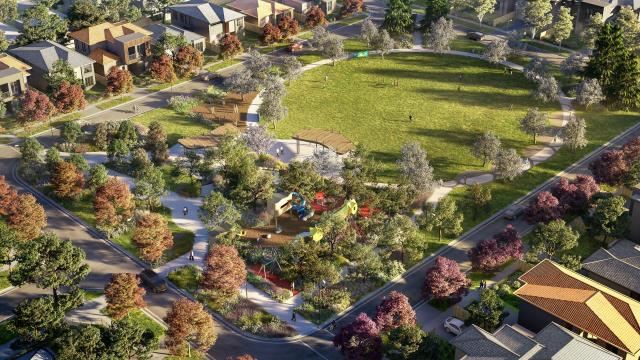
As part of the City of Casey’s membership with the Municipal Association of Victoria (MAV), the council will be calling on a Green Streets initiative at the State Council meetings — a local initiative that prioritises greener and cooler neighbourhoods.
The initiative aims to achieve more than 30 per cent tree canopy coverage by planting between two and 2.5 trees per lot.
Design elements would include engineered root growth zones with high-quality soil backfill, integrated landscaping within street layouts and use of sustainable construction materials aligned with circular economy principles.
The council states the model delivers environmental and public health benefits, including reduced urban heat, improved air quality and enhanced community wellbeing.
The motion, endorsed at Council’s February meeting, will be submitted for consideration at the 2026 MAV State Council meetings in May and October.
Delivered in partnership with developer Balcon, the Green Street project would reimagine traditional suburban subdivision design by prioritising canopy cover, pedestrian amenity and climate resilience over car-dominated streetscapes.
Councillor Jennifer Dizon, who moved the motion, said that the endorsement of the Green Street initiative at the State Council would be a “significant step” towards environmental developments.
Already, Green Streets in Orana, an estate in Clyde, successfully kicked off, garnering national attention after its win of the Strategic Foresight & Innovation Award at the 2025 National Growth Areas Alliance (NGAA) Awards.
The project was designed to achieve more than 30 per cent canopy cover by planting 2 to 2.5 trees per lot, more than double the industry standard.
According to the council, over 2700 trees have been planted at Orana Estate.
If adopted by the MAV and supported by member councils, the motion could elevate Green Streets from a local innovation to a statewide planning conversation.
The 2026 MAV State Council meetings taking place in May and October will determine whether the proposals gain formal backing from Victoria’s 79 member councils.